Explore Euclid's Elements online
English Translations
In 1570 the printer John Daye released the first English translation of Elements. The translation was completed by Cambridge maths graduate and Lord Mayor of London Henry Billingsley under the title The elements of geometrie of the most auncient philosopher Euclide of Megara, which confuses our Euclid ('of Alexandria') with another ('of Megara'), who was a Greek Socratic philosopher. A more applause-worthy addition to Euclid of Alexadria's work, however, was a number of flaps of paper pasted such that they could be folded out to demonstrate the three-dimensional propostions of Book XI. Chetham's Library in Manchester have a copy of what is not only the first English translation of Euclid's Elements, but also one of the oldest English "pop-up" books, and they have shared some photos in this blog post.
In 1758, professor of Mathematics at the Royal Academy in Woolwich, John Cowley, produced an appendix to Elements which contained forty-two pop-up demonstrations of various propositions, two examples of which can be seen in this blog post from UCL.
In 2004 The Clay Mathematics Institute funded the digitisation of MS D'Orville 301 (the oldest complete surviving manuscript of Elements, copied in 888 CE in Constantinople (now Istanbul)), held at the Bodlein Library at the University of Oxford. These scans are available to view online for free, alongside transcriptions and English translations of the Greek text: claymath.org/euclid_index/
Explore themes from Euclid's Elements
Below are selected resources aimed at exploring aspects of the scientific and mathematical principles encountered in Elements.
Note: This is ongoing work and will be updated, so if you're interested do bookmark it and come back later. If you think a fantastic relevant resource is missing, don't hesitate to tell me about it.
Foundational Principles (Book I)
Definitions: Clear meanings assigned to fundamental geometric objects like points, lines, and angles.
Postulates (Axioms): Basic geometric assumptions governing constructions using only an unmarked straightedge and a compass.
Common Notions: General logical and mathematical truths, such as the transitivity of equality.
Books I–IV (Plane Geometry)
Covers triangles, parallels, the Pythagorean theorem, circle properties, and inscribed/circumscribed polygons.
Work through the first Propositions from Book I in this interactive by Software Developer James Weber: euclid.jamesweber.dev/
Book V (Proportion)
Establishes a general theory of proportion applicable to magnitudes of any kind.
Book VI (Applications of Proportion)
Applies the theory of proportion to similar geometric figures.
Books VII–IX (Number Theory)
Explores divisibility, prime numbers (including the proof that primes are infinite), the greatest common divisor, and number ratios.
Book X (Incommensurable Magnitudes)
Classifies irrational and incommensurable line segments.
Books XI–XIII (Solid Geometry)
Examines three-dimensional figures, solid angles, and the construction of the five regular Platonic solids.
Get a copy of Euclid's Elements
If you'd like your own copy of Elements, a truly ancient version will set you back quite a bit, but there are some readily available modern translations, such as:
Note: Making a purchase after visiting one of the links above may result in me receiving a small amount of comission, for which I thank you very much.
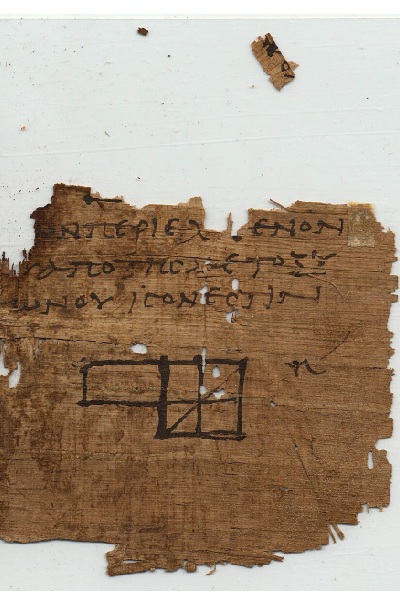
Header image: University of Pennsylvania Museum of Archaeology and Anthropology, CC BY-SA 4.0, via Wikimedia Commons.