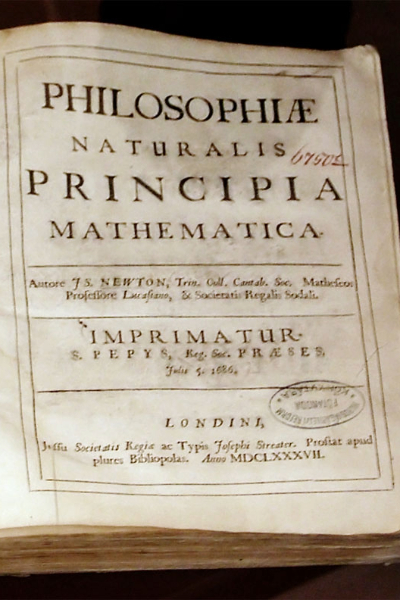
Explore Newton's Principia online
In the frame below you can browse a first-edition copy of Newton's Principia. This a digitised version of a first-edition of the book in Latin, contributed to The Internet Archive by Boston Public Library. Even if, like me, you haven't learnt to read Latin, it can be interesting to scroll through and find some diagrams: think about what they might be intended to demonstrate. Maybe you'll even recognise some from your own experience in mathematics education!
Other digitised versions of the work are available to be browsed online. For example, the Cambridge University Library website provides access to a first edition of Principia that contains annotations by Newton himself, working towards a new edition of his work.
Whilst Newton wrote his Principia in Latin, a full English translation is available via Wikisource, and there are also ebook versions available, many of which are free of charge. If you do decide to read this book, do be aware that many of the terms Newton uses may not be recognisable even though the concepts they refer to are known to you. Some examples to look out for are given in the table below:
| Newton's phrasing | Modern (British) English phrasing | Mathematical context |
|---|---|---|
| Quantity of Matter | Mass | The amount of matter in an object, traditionally measured in kilograms (kg). |
| Quantity of Motion | Momentum | An object's mass multiplied by its velocity. It is conserved during crashes and collisions. |
| Vis Insita | Inertia | An object's natural resistance to changing its state of motion or rest. |
| Fluxion | Derivative / Rate of change | How quickly a variable changes over time, such as tracking instantaneous speed. |
| Fluent | Integral | The total accumulated quantity or area found by reversing a rate of change. |
| Ultimate Ratio | Limit | The exact mathematical value that a changing geometric shape or ratio gets closer and closer to. |
| In a duplicate ratio of... | Proportional to the square of... | A relationship where squaring the first number determines the second (e.g., if distance doubles, gravity drops to a quarter). |
| In a subduplicate ratio of... | Proportional to the square root of... | A relationship where taking the square root of a value determines its output. |
| In an inverse ratio of... | Inversely proportional to... | A relationship where as one value doubles, the connected value is halved. |
| Perpendicular Descent | Freefall under gravity | An object falling straight downwards through space under the constant acceleration of gravity. |
Explore themes from Newton's Principia
Below are selected resources aimed at exploring aspects of the scientific and mathematical principles encountered in Principia.
Definitions, Axioms, & Laws of Motion
Newton begins by setting down some preliminary information, including definitions of words, phrases and principles that act as the initial building blocks from which he will build his arguments. For example, he defines a number of physical quantities (such as quantity of motion and impressed force that possess both magnitude and direction. Although not explicitly invented until the 19th century, this will be recognisable to many modern students of (e.g. GCSE) mathematics as examples of "vectors". In fact, his Corollary 1 provides one of the first formal proofs of what some readers may know as the 'parallelogram of forces': Newton's diagram towards the bottom of page 13 of Principia can be compared with this modern interactive demonstration.
The Principia is separated into three "books" which together chroncicle a single, logical argument that moves from pure theory to the real universe. Book I builds the mathematical rules of motion in an ideal, empty void; Book III takes those rules and applies them directly to the actual planets and stars to prove how gravity works across the cosmos. Book II serves as the vital bridge between them, systematically disproving competing physics theories about space fluids so that the empty-space model of Book I can be safely applied to the real world in Book III.
Book I: The Motion of Bodies (in Unresisting Mediums)
After establishing his famous Three Laws of Motion, Newton uses pure geometry to calculate how objects behave when pulled toward a central point, like a planet or a magnet. He mathematically proves that this central pulling force naturally creates elliptical orbits (building on Kepler's discovery that this was truly the shape of the orbital paths followed by the planets around the Sun). This layed the groundwork for modern physics and orbital mechanics by stripping away real-world messiness like air resistance.
Whilst Newton's version of calculus is not explicitly introduced in Principia, some of its core ideas are hidden in plain sight. See, for example, the diagram accompanying his explanation of 'ultimate ratios' in Lemma IV of Section 1 (at the bottom of page 28): that Newton's parallelogram method bears a striking resemblance to every modern maths stduent's first introduction to integration is no coincidence.
Book II: The Motion of Bodies in Resisting Mediums
The real-workd messiness ignored in Book I is introduced by calculating how objects move through fluids like water and air. Newton examines how friction, air resistance, and liquid density slow things down, directly tackling the mechanics of waves, pendulums, and swirling whirlpools. He ultimately uses these calculations to disprove the popular contemporary theory that planets are carried through space by giant cosmic vortexes of fluid. More subtly, this is an excellent example of the mathematical problem solving technique of reducing a problem to its simplest form in order to build a working model, and then reintroducing complexity as necessary for the model to match reality.
In Proposition II, Theorem II, of Section I, Newton tackles the effect of a body falling under gravity whilst also being subject to a resistive force from the medium that it is falling through. Air resistance is an example of this: click here to explore this concept via an interactive tool.
Book III: The System of the World
Book III applies the abstract maths of the first two books to observations of our actual universe to reveal the law of Universal Gravitation. Newton moves from theoretical geometry to real astronomy, showing that the same force pulling an apple to the ground also holds the Moon in orbit and dictates the tides. This final section unites the heavens and Earth under a single set of physical laws, explaining the precise behavior of planets, moons, and comets.
A later edition of this third book of Principia (published posthumously in 1728) contained an addition which was to become relatively famous: Newton's cannon. This thought experiment imagined a cannon on top of a mountain so high its peak reaches out of the Earth's atmosphere (so air resistance can be ignored). If the cannon fires a ball with different initial velocities, different things will happen: at low speeds, the ball will fall back to Earth. At very high speeds, the ball will escape Earth on a parabolic or hyperbolic trajectory. Somewhere in between, there are speeds which will put the ball into orbit around the Earth, including one which is circular. You can play with this idea in the Newton's Cannon interactive tool.
Header image: "Newton's Principia Cover Detail" by [Author Name], used under CC BY-SA 4.0. Sourced via [Wikimedia Commons Link].